Friday, October 17, 2014

Israeli books: Assaf Gavron's The Hilltop is set in a West Bank settlement

The Hilltop book coverHilltop_HebrewFrontCover

The Hilltop is recommended to all readers who enjoy a good story grounded in current events.” -- from my New York Journal of Books review. Also see my examiner article, which begins with the next paragraph.

Israeli books: Assaf Gavron's The Hilltop is set in a West Bank settlement

Israeli fiction writers have set their narratives in rural kibbutzim, moshavim, in small mainly Sephardic towns, in urban settings in Israel’s three largest cities, as well as overseas, and now novelist Assaf Gavron has set his fifth novel and seventh book The Hilltop (published last week by New York publisher Scribner) in perhaps the most controversial setting of all, an unauthorized West Bank settlement. In my New York Journal of Books review I recommend The Hilltop “to all readers who enjoy a good story grounded in current events.”

British author William Sutcliffe also set his Young Adult novel The Wall in what appears to be a West Bank settlement, but his settlers are represented by a single abusive two dimensional character. By contrast, Gavron’s settlers in The Hilltop are more complicated and more believable characters.

Roughly one in twenty Jewish Israelis lives in a West Bank settlement. Four fifths of these settlers live in settlements close enough to Israel’s 1949 armistice line that they could be incorporated into Israel as part of land swaps in a comprehensive peace agreement.

Gavron’s settlers in the fictional settlement Ma’aleh Hermesh C are among the fifth of settlers who would have to be evacuated in the event of such a peace agreement, and since it is an unauthorized settlement, an order for its evacuation has already been issued. Whether that evacuation order will ever be executed is a central plot element in The Hilltop.

My recommendation “to all readers” in my NYJB review may be too broad. Perhaps the ideal reader is one who can care about the novel’s characters (even though they show no empathy toward their Palestinian neighbors) while at the same time disapprove of their settlement enterprise and its objectives, one of which is to prevent a comprehensive peace agreement to end the Israel-Palestine conflict through the partition of the country into two states, Israel and Palestine.

This past spring U.S. Secretary of State John Kerry said, “A two-state solution will be clearly underscored as the only real alternative. Because a unitary state winds up either being an apartheid state with second-class citizens—or it ends up being a state that destroys the capacity of Israel to be a Jewish state.”

There are indeed Israelis who share Secretary Kerry’s apprehensions, but they include some of Israel’s newly affluent shoppers who consume organic produce and dairy products produced in settlements similar to Gavron’s fictional Ma’aleh Hermesh C. For a fuller discussion of The Hilltop see my NYJB review.
Assaf Gavron

Friday, September 12, 2014

Jewish books: The Betrayers by David Bezmozgis

The Betrayers book cover
 “The Betrayers succeeds by combining thought provoking ethical dilemmas with dramatic tension in an engaging prose style and is enthusiastically recommended.” - from my New York Journal of Books review (which includes spoilers). For additional remarks, excerpts, and an exploration of the novel as a roman a clef see my examiner article, which begins with the next paragraph.

Jewish books: David Bezmozgis' roman a clef second novel The Betrayers succeeds

Encyclopaedia Britannica defines "roman à clef, ( French: 'novel with a key')" as a "novel that has the extraliterary interest of portraying well-known real people more or less thinly disguised as fictional characters." In my New York Journal of Books review (which includes spoilers) of David Bezmozgis' second novel The Betrayers (which will be published by Little Brown on September 23, 2014) I describe its protagonist Baruch Kotler as combining "some aspects of Israeli foreign minister Avigdor Lieberman and even more of those of Soviet dissident turned Israeli politician turned NGO executive Natan Sharansky."

Let's explore the similarities and differences between these fictional and real life men. Like Sharansky, Kotler is short and bald, was a human rights activist in the USSR who sought the right to emigrate to Israel, was sentenced to 13 years imprisonment in the Soviet Gulag (Kotler serves all 13 years but Sharansky was released after nine years in a prisoner swap) which separated him from his wife who had already emigrated, upon his release emigrated to Israel and became a successful politician leading a political party representing a voting bloc of fellow Russian immigrants. Kotler remains in politics in 2014 while in real life Sharansky left politics in 2006. Avigdor Lieberman filled the vacuum created by Sharansky's exit from politics and created his own political party which won the allegiance of the same Russian immigrant voters who had previously supported Sharansky. Like Sharansky, Kotler is a saintly idealist, but unlike Sharansky (as far as we know) the fictional Kotler is also an adulterer. Unlike Sharansky, and like Lieberman, Kotler stood trial in Israel and was exonerated. Kotler is six years younger than Sharansky and four years older than Lieberman.

In my NYJB review I advise liberal readers to "ignore or overlook the protagonist’s right-wing Zionist politics; the correctness of his principles matters less than his steadfastness in standing by them." It is interesting to note how in a swing of the political pendulum many post-Communist Russian gentiles have become conservative Christians and likewise many Russian Jews (both in the diaspora and in Israel) have become right-wing Zionists.

Bezmozgis uses a Russian television game show to represent the vacuousness of contemporary Russian popular culture: "This is what they had raised from the scraps of communism. This was what the struggle for freedom and democracy had delivered. Bread and circuses. Mostly circuses. From one grand deception to another was their lot. First the Soviet sham, then the capitalist. For the ordinary citizen, these were just two different varieties of poison. The current variety served in a nicer bottle."

The novel's title refers not only to Kotler's adultery but also to the supposed friend who decades earlier had denounced Kotler to the KGB. In this book about moral choices Kotler, who refuses to be politcally blackmailed, advises his son who contemplates disobeying a military order he considers immoral, "If you think you have no choice, look harder. There is always a choice. A third way, if not a fourth. Whether we have the strength to make those choices is another matter. Of which I am no less guilty than anyone else."

The advance uncorrected proof of The Betrayers refers to the novel's venue as “Yalta, Crimea, Ukraine” and the date as summer 2014, but in the real world Crimea was invaded and annexed by Russia in March 2014. In an afterward Bezmozgis acknowledges “Clearly setting my novel in the summer of 2014, as I intended, is no longer feasible. I will have to find another solution.” It will be interesting to see what that solution looks like in the published edition.

For a fuller discussion of the novel see my NYJB review, which concludes, "The Betrayers succeeds by combining thought provoking ethical dilemmas with dramatic tension in an engaging prose style and is enthusiastically recommended." 
  David Bezmozgis David Bezmozgis

Sunday, September 7, 2014

Book review: 10:04 by Ben Lerner

1004bookcover “. . . the pleasure this novel provides is found less in what happens to the characters than in the language Lerner commands to relate that and his various cogitations, as well as in time spent in the company of a first rate mind.” -- from my New York Journal of Books review. For additional remarks and excerpts from the novel also see my examiner article, which begins with the next paragraph.

Books: Ben Lerner's 10:04 fulfills and surpasses the promise of his 2011 debut

Ben Lerner’s second self-referential novel 10:04, which is published this week by New York publisher Farrar, Straus and Giroux’s Faber and Faber imprint, fulfills and surpasses the promise of his 2011 debut novel Leaving Atocha Station. His best writing, however, is found in his poetry. In my New York Journal of Books review of 10:04 I write, “the pleasure this novel provides is found less in what happens to the characters than in the language Lerner commands to relate that and his various cogitations, as well as in time spent in the company of a first rate mind.”

One of the plot elements in 10:04 is how Lerner’s conception of the work we are reading evolves. When at the outset his agent conveys the news that a handsome advance for the as yet unwritten book is forthcoming and asks what he plans to write, the fictional Lerner answers to himself “‘I’ll project myself into several futures simultaneously,’ I should have said, ‘a minor tremor in my hand; I’ll work my way from irony to sincerity in the sinking city, a would be Whitman of the vulnerable grid.’” His conception of the book will continue to evolve at different points in the narrative until he replaces the earlier concept with the book we are reading.

Lerner like his fellow New Yorkers has a heightened awareness of the electrical grid’s vulnerability because the action of the novel takes place between Hurricane Irene (which was disastrous for upstate and parts of New England but a big nothing here in the Big Apple) and Super Storm Sandy (which destroyed shorefront homes and blacked out parts of the city and left other parts unaffected other than rerouted transit lines).

10:04 also includes other bits of recent history such as Occupy Wall Street one of whose out of town protestors Lerner provides a shower and home cooked meal. An inexperienced cook, as Lerner cooks for a stranger he chastises himself for not reciprocating the meals his friends have cooked for him, “but I could dodge or dampen that contradiction via my hatred of Brooklyn’s boutique biopolitics, in which spending obscene sums and endless hours on stylized food preparation somehow enabled the conflation of self-care and political radicalism.” The novel also includes a description of a work shift at the Park Slope Food Co-op.

The novel’s title 10:04 comes from Christian Marclay’s 24 hour video The Clock which the fictional Lerner watches and critiques. “When I looked at my watch to see a unit of measure identical to the one on the screen, I was indicating that a distance remained between art and the mundane.” And that reminds us of the distance and presumed difference between Lerner’s fictional narrative and the life he actually lived at that time.

In his previous novel Leaving The Atocha Station the fictional Lerner is a self-described bipolar compulsive liar, but in10:04 he appears comparatively even tempered. As I point out in my NYJB review, in 10:04 “the fictional Lerner has a real potentially life threatening medical condition, a minuscule perforation in his aorta, that must be monitored.” And having something real to worry about turns out to be emotionally healthy, as the fictional Lerner remarks, “the irony of my recent cardiac diagnosis was that it gave me an objective reason for my emotional turbulences and so was, in that sense, stabilizing: now I was reckoning with a specific existential threat, not just the vacuum of existence.”

So how do things turn out for Lerner? To learn that you’ll have to read the book, a fuller discussion of which is found in my NYJB review.
Ben Lerner Ben Lerner

Tuesday, August 5, 2014

Jewish books: Stephanie Feldman's The Angel of Losses is an auspicious debut

angeloflossesbookcover "Stephanie Feldman’s debut novel The Angel of Losses, which was published last week by New York-based HarperCollins imprint Ecco Press, is a welcome addition to the Jewish fantasy fiction genre." --examiner.com

In my New York Journal of Books review of the novel I write, “The Angel of Losses is recommended to nerdy (in the best sense of the word) secular Jewish and philo-Semitic readers whose genre interests include the confluence of contemporary and fantasy fiction.” Read that review first. Additional remarks that appeared in a different and now defunct publication begin with the next paragraph.

Jewish books: Stephanie Feldman's The Angel of Losses is an auspicious debut

Stephanie Feldman’s debut novel The Angel of Losses, which was published last week by New York-based HarperCollins imprint Ecco Press, is a welcome addition to the Jewish fantasy fiction genre. In my New York Journal of Books review of the novel I write, “The Angel of Losses is recommended to nerdy (in the best sense of the word) secular Jewish and philo-Semitic readers whose genre interests include the confluence of contemporary and fantasy fiction.”

The novel might also appeal to the growing number of gentiles who, like its protagonist Marjorie Burke, discover they have Jewish ancestry, as well as to those who always knew that a parent or grandparent is Jewish. In my NYJB review I cite the case of former Secretary of State Madeleine Albright who learned at age 60 that her parents were Jewish apostates. Current Secretary of State John Kerry, on the other hand, has always known that his paternal grandparents were born Jewish. In my own family some of my paternal great-uncles married Protestants and raised their children in their mother’s faith. But one of my dad’s Protestant first cousins was fascinated by her Jewish father’s religious heritage, converted to Judaism, and married a rabbi.

In The Angel of Losses Marjorie’s sister Holly converts to Judaism without knowing about her grandfather’s ancestry. What tips Marjorie off that her late grandfather might have been Jewish are stories he wrote about a character he called The White Rebbe. The stories also draw the attention of her brother-in-law Nathan who is a member of a mystical Jewish sect called The Berukhim Penitents who are mentioned in the stories.

Feldman does not refer to the Berukhim Penitents as Hasidic, and even dates the sect’s founding to the Sixteenth Century thus predating Hasidism which started in the Eighteenth Century, but the Hasidim are the only sects who call their rabbis rebbe. Moreover the Berukhim Penitents are so preoccupied with the coming of the messiah that when their rabbinic leader died centuries ago no successor was chosen, and instead they await their deceased rabbi’s return.

This sounds a lot like the Bratslav (or Breslov) Hasidim who have remained devoted to their story telling rebbe Nachman since his death in 1810 and have never chosen a successor, and instead await Nachman’s return as the messiah. Chabad Lubovitch is another messianic Hasidic sect that has not chosen a successor since it’s seventh rebbe’s death in 1994 and likewise awaits his messianic return. Feldman’s fictional Berukhim Penitents combine aspects of both sects, and like the Lubovitch Hasidim were originally based in Lithuania, whereas the Bratslav Hasidim were from the Ukraine. In his doctoral dissertation Conservative Rabbi David Siff points out that the two sects that don't have a living rebbe are the most messianic of all the Hasidic sects.

One detail that seemed odd to me was when Feldman referred to Lithuanian Orthodox synagogues as temples. Reform Judaism often refers to its houses of worship as temples, but that appellation is rarely used among the Orthodox. But that is a minor quibble that is easy to overlook in this entertaining and enjoyable read. For a fuller discussion of the novel read my NYJB review.sbfeldman Stephanie Feldman

Wednesday, July 2, 2014

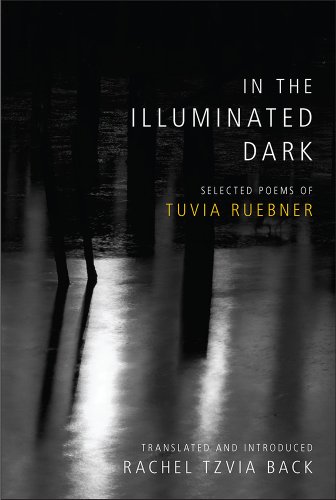
Book review: In the Illuminated Dark: Selected Poems of Tuvia Ruebner

intheilluminateddarkbookcover    "Anglophone readers (especially those who also read Hebrew) will find both this handsome book’s bilingual presentation of Ruebner’s selected poems, and his heart wrenching backstory described by translator Rachel Tzvia Back in her informative introduction and endnotes, compelling reading."

My two part review begins with the poet's bio and backstory in New York Journal of Books and continues with a discussion of his poems in an article that appeared in a different and now defunct publication, which begins with the next paragraph.

Israeli books: In the Illuminated Dark: Selected Poems of Tuvia Ruebner

Although Tuvia Ruebner is the author of 15 books of poetry in Hebrew and nine translated into German spanning six decades, twice winner of Israel’s Prime Minister’s Prize, 2008 winner of the Israel Prize, as well as Germany’s Konrad Adenauer Prize, only a handful of his poems were available in English in anthologies and literary magazines prior to the joint publication this spring by by Hebrew Union College Press and University of Pittssburgh Press of In The Illuminated Dark, a bilingual edition of his selected poems translated by Rachel Tzvia Back. I am grateful to Adam Kirsch's Tablet article on Ruebner which introduced me to this amazing poet.

In my New York Journal of Books review I write, “Anglophone readers (especially those who also read Hebrew) will find both this handsome book’s bilingual presentation of Ruebner’s selected poems, and his heart wrenching backstory described by translator Rachel Tzvia Back in her informative introduction and endnotes, compelling reading.” See that review for the backstory.

Suffice to say that the predominant theme in Ruebner’s poetry is loss; loss of parents, grandparents and a sister in the Shoah, of his first wife to a traffic accident, and of his youngest son Moran who cut off contact with his parents during a trip overseas. In the untitled poem that begins the section of the book entitled History Reubner lists all the relatives, friends and colleagues whom he has lost devoting one line to each person in the 30 line poem except for Moran who gets five lines. Ruebner also refers to Moran in the poems “1983” (1990), “Soldiers’ Memorial Day” and “Moonlit Night (2)” (2002), “Not Every Day” (2009), and “A Meeting in Venice,” “Avraham,” “Father,” and “He” (2013).

“Not Every Day” is an apology. When Moran returned from combat in Israel’s first Lebanon War he had changed, but his parents didn’t notice. Ruebner doesn’t specify how Moran had changed; perhaps he had PTSD. On his way to South America Moran stopped in Cambridge, MA where his father was spending a sabbatical at Harvard to bid his parents farewell. After a few letters all traces of him were lost. In “Not Every Day” Ruebner writes,

“I embraced you there when we parted at the winter airport,

a leave-taking seared into my flesh. You asked ‘why?’

for something foreign had wormed its way between us after that cursed war.

You returned to us different from what you had been before, but I was

tense, unable to concentrate, troubled by the sabbatical that had

come to nothing.

How sorry I am, how deeply repentant, for not understanding

what you went through without us, for responding severely.”

After telling Moran how much he misses him Ruebner concludes the poem, “Self pity is contemptible. But your love is eating me alive.”

It’s probably just a coincidence, but the venue and the line “something foreign had wormed its way between us” reminds me of a Turkish Jewish character in Mario Levi’s novel Istanbul Was a Fairy Tale who becomes a Mormon while studying at Harvard and writes to his family informing them that he intends to have no further contact with them. But in Reubner’s case it is the parent who is at Harvard and the adult child is only passing through en route to another destination, so the coincidence in all likelihood is only a superficial resemblance.

In “He” Ruebner writes about not being able to stop thinking about him (presumably Moran) and even wanting to kill him, which calls to mind the parents in David Grossman’s Falling Out of Time who are tormented by the memory of their deceased children. Writing is Ruebner’s only remedy: “Only when I write about him does he leave me be.”

Not all of Ruebner’s poems are that bleak. “What Joy” (2013) describes the joy Ruebner feels upon learning he has become a great-grandfather and ends with “…a great-grandfather embracing a great-grandmother/and kissing her on the mouth as though he were a boy of twenty.” “Chimes” (2009) playfully closes with a feminine rhyme of his wife’s name Galila and the Hebrew word for chimes mitsilah, which in turn resembles the Hebrew verb to save or rescue hitsil; perhaps he is crediting Galila with psychologically rescuing him.

Neither of Ruebner’s remaining children live in Israel. Miriam, his daughter from his first marriage married a man from Iceland and lives there with her children and grandchildren, and his son Idan is a Buddhist monk who lives in Nepal, but both are in frequent telephone contact with Ruebner. I wonder whether Reubner’s ambivalence about Israel, which he expresses in his protest poems, influenced his children’s decision to emigrate.

There is a saying among literary translators that literal word for word fidelity to a text betrays the text. In my NYJB review I praise Back’s translation of Ruebner’s poetry which she creatively does not betray. In “Poem” (2009), for example, Ruebner’s rhyming couplet in the fourth stanza does not rhyme in English, but in the fifth stanza Back adds a word not found in the Hebrew to achieve a slant rhyme. And while the first word of the second line of “The Tower of Babel (2)” (1999) means “blind” in both versions, in the Hebrew the adjective blind modifies a noun in the first line, while in Back’s English version it modifies a different noun in the second line.

Ruebner is an award winning translator between Hebrew and German (Agnon into German and Goethe into Hebrew) and in all likelihood appreciates both the difficulties his verse posed for Back and her workarounds. Next spring Late Beautya book of Ruebner’s recent poems translated by a different team of translators will be published by Zephyr Press, and it will be interesting to compare their versions with Back’s.

I urge readers who have at least intermediate proficiency in Hebrew to use a dictionary or dictionary app and read Ruebner in the original, and I likewise urge those readers who have only prayerbook Hebrew to read the poems out loud even without understanding what the words mean to get some sense of the music of Ruebner’s poetry.

Ruebner is also a gifted photographer, and his poetry is not only sonorous but also visual, especially his travel, nature, and ekphrastic poems. Let’s conclude with his “Untitled” (2013)

“Like leaves driven in wind.

Like tattered remnants of a scene.

Like a night’s sobbing.

Like the moon’s red blindness.

Like the abyss of four in the morning.

Not like.”
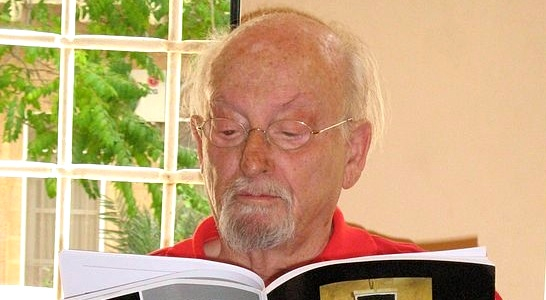
tuviaruebnerTuvia Ruebner

Saturday, June 7, 2014

Book review: A Replacement Life by Boris Fishman


Image
Slava Gelman, the protagonist of Boris Fishman's debut novel A Replacement Life, fabricates Holocaust narratives for elderly Russian immigrants' reparations claims applications. In my NYJB review I write, "Slava knows that to make his stories convincing he has to get the details right, and despite the leaps of faith Fishman demands he provides more than enough correct details and well crafted figurative turns of phrase to convince most readers to go along with him—and those who do will be amply rewarded by this multidimensional and handsomely written debut novel." For additional remarks about A Replacement Life see my examiner article, which begins with the next paragraph.

Meet Boris Fishman the newest star novelist of the Little Odessa Renaissance

With the publication this week of his debut novel A Replacement Life by New York based publisher HarperCollins Boris Fishman joins the ranks of fellow writers of The Little Odessa Renaissance who immigrated from the Soviet Union to The United States and Canada as children including Gary Shteyngart, David Bezmogis, Anya Ulinich, Nadia Kalman, and Ellen Litman all of whom explore the theme of having one foot in Russian and the other in American culture.

Fishman’s protagonist Slava Gelman is an aspiring writer who fabricates Holocaust narratives for fraudulent reparation applications on behalf of Russian Jewish immigrants of his grandparents’ generation. In my New York Journal of Books review of the novel I write, “Slava knows that to make his stories convincing he has to get the details right, and despite the leaps of faith Fishman demands he provides more than enough correct details and well crafted figurative turns of phrase to convince most readers to go along with him—and those who do will be amply rewarded by this multidimensional and handsomely written debut novel.”

I really enjoyed reading A Replacement Life, but besides “the leaps of faith” my other reservation concerns the way Fishman portrays his fellow immigrants from the former Soviet Union as a community of liars and cheats. I hope that defamatory characterization is an overly broad generalization. For a more detailed discussion of the novel read my New York Journal of Books review.
ImageBoris Fishman