Mostly a links blog with occasional commentary on the linked articles (since 2010 mostly my book reviews) and infrequent personal updates.
I am a 64 year old married writer. See my website for my current writing projects and to download my ebooks; my about me page has links to my various web 2.0 venues.
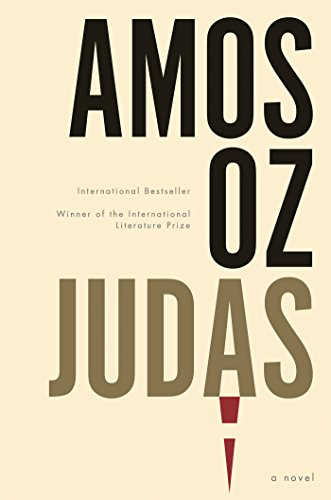
“For Oz’s fans and liberal Zionist fiction readers Judas is a required text whose writing is its own reward.” -- from my review of in New York Journal of Books
Here is my New York Journal of Books review of Amos Oz's new book of short stories Between Friends. As I discuss in my examiner article, this book and his previous book of short stories reflect two distinct emotional reactions to capitalism's defeat of socialism in Israeli society and its economy.
In my other gig I write book reviews for New York Journal of Books; here is a list of Jewish fiction and poetry books I reviewed in the past year in reverse chronological order:
Adult Fiction:
Scenes from Village Life by Amos Oz, translated by Nicolas de Lange. In my New York Journal of Books reviewof the book I write: “Loneliness, lethargy, depression, and vague but unmistakable feelings of anxiety pervade most of the characters and the overall mood of the book. These senses of aloneness, isolation, and unease are reminiscent of the short stories of Anton Chekhov and Sherwood Anderson. Mr. Oz’s stories almost have a sense of the uncanny yet contain no supernatural elements.”
Paper Conspiracies by Susan Daitch, takes an indirect approach to late Nineteenth Century France’sDreyfus Affair by way of peripheral minor actors in the scandal and via cinema pioneer Georges Mèliés‘ contemporaneous dramtized documentary film L’affaire Dreyfus. The novel’s six sections alternate between 1990s New York and Paris in the 1890s, 1930s, and 1968. In my New York Journal of Books review of the novel I enthusiastically recommend the book “to fans of highbrow, erudite historical fiction. Readers who enjoy the novels of Umberto Eco, for example, will probably also enjoy those of Ms. Daitch.” I also draw an analogy between late Nineteenth Century French anti-Semitism and Twentyfirst Century American Islamophobia.
The Little Bride by Anna Solomon. In my New York Journal of Books review I describe the book as “. . . a plot-driven novel conveyed in crisp, descriptive, and thought-provoking prose via an engagingly intelligent third-person narrator. . . . an auspicious debut” and recommend it to both adult and precocious young adult readers.
Seven Days in Rio by Francis Levy is a hilarious account of a sixty-something New York Jewish mama’s boy and sex tourist’s vacation in Rio de Janeiro, Brazil.
Leeches by David Albahari, translated by Ellen Elias-Bursac. In my New York Journal of Books review of Leeches I write: “David Albahari’s challenging yet engaging, cerebral, magical-realist, experimental, post-modernist novel Leeches provides a portrait of life in Belgrade, capital of an ideologically charged and xenophobic Serbia, in the months preceding the NATO bombing campaign. As elsewhere in history, Belgrade’s Jewish community is the proverbial canary in the Serbian coal mine; considering the Serbian government’s behavior toward other former Yugoslav republics and their ethnic groups, this should not be surprising.”
Young Adult Fiction:
Vaclav and Lena by Haley Tanner does not meet the high literary standard of the adult books listed above, but in my New York Journal of Books reviewI describe the book as “a tale of unconditional love; of attachment, separation, and reunion; and of trauma and healing.” It’s an engaging read that will appeal to teens, their parents, and anyone interested in the immigrant experience.
The Hunger Moon: New and Selected Poems 1980-2010 by Marge Piercy. In my reviewinNew York Journal of Books in addition to mentioning that Piercy is a political and feminist poet, I note, “The Hunger Moon, her second volume of selected poems, a rich selection from the last three decades, … includes: narrative poems about her childhood in Detroit, young adulthood in Manhattan, everyday life with her husband and cats on Cape Cod where they are year round residents, among other subjects on all of which she is a terrific storyteller; nature poems that describe the fauna and flora of the Cape; love poems, some of which attest to the strength, devotion and passion of her current marriage, while others reflect the pain of less healthy previous relationships, pain that still smarts despite her current conjugal happiness; and religious poems that are popular choices for reading out loud at Jewish life cycle events, some of which are reprinted in “additional readings” anthologies meant to supplement non-Orthodox Jewish prayer books.”
Mr. Khoury was not only disconsolate, he was appalled. A prominent Jerusalem lawyer who often fights Israeli confiscations of land from Palestinians, he considered violence a toxin corroding his nation’s core.
So in memory of George, a charismatic law student and musician, Mr. Khoury did something that shocked many in his community. He paid for the translation into Arabic of the autobiography of Israel’s most prominent author and dove, Amos Oz.
The Arabic version of the book, “A Tale of Love and Darkness,” went on sale late last month in Beirut, Lebanon, where it has received positive commentary — notably by Abdo Wazen, cultural editor of the pan-Arab newspaper Al Hayat — as well as some angry reaction. The book is due to be distributed more widely in the region in the coming weeks.
In explaining his decision, Mr. Khoury said that literature was an important bridge and that he had a specific goal in mind with this book, a point he includes in a preface to the translation.
“This book tells the history of the rebirth of the Jewish people,” he said as he sat in his law office. “We can learn from it how a people like the Jewish people emerged from the tragedy of the Holocaust and were able to reorganize themselves and build their country and become an independent people. If we can’t learn from that, we will not be able to do anything for our independence.”
Mr. Khoury is hardly a Zionist. His family’s land near Nazareth, about 750 acres, was seized by Israel “for security purposes,” he said, shortly after the creation of the state, bankrupting his family.
His father, Daoud, an educated man who fought the confiscation with every fiber of his being, was barred by the Shin Bet internal security force from holding even menial jobs for some 20 years. He ultimately did get work, as an accountant at the King David Hotel in Jerusalem.
Shortly thereafter, in 1975, he was killed in a Palestinian terrorist attack in downtown Jerusalem when a bomb placed in a refrigerator killed 13 people. Elias Khoury was only feet away at the time.
Having lost his land to Israel and his father and son to Palestinians, Mr. Khoury is in a rare position to petition both sides to re-examine themselves. A Palestinian nationalist, fluent in Hebrew and English, Mr. Khoury said he believed that the Oz autobiography, with its account of Jewish refugee life here in the 1930s and ’40s, could be a vehicle to help Palestinians and other Arabs see the Jews in a different light.
The book is widely considered Mr. Oz’s masterpiece and one of the most important books in contemporary Hebrew. While not explicitly about coexistence, as some other of his nonfiction works are, it paints a deeply moving picture of Jewish refugees from Europe trying to find their way.
Mr. Wazen, the Beirut critic, called Mr. Oz’s writings beautiful and praised the “unique world” created in them, saying this “enemy” was certainly worth reading.
Sari Nusseibeh, a Palestinian philosopher who wrote his own powerful autobiography of growing up in Jerusalem in the same era, “Once Upon a Country,” said in that book’s opening that it was upon reading Mr. Oz’s volume that he was struck by the parallel existences of Jews and Palestinian Arabs of the time.
“Weren’t both sides of the conflict totally immersed in their own tragedies, each one oblivious to, or even antagonistic toward, the narrative of the other?” he wrote. “Isn’t this inability to imagine the lives of the ‘other’ at the heart of the Israeli-Palestinian conflict?”
Mr. Khoury believes it is.
“If we don’t understand each other, there will always be suspicion and gaps that can’t be bridged,” he said.
Mr. Oz, who has come to know the Khoury family — Elias, his wife, Rima, and their two other children — through this project, said by telephone that their sponsorship of an Arabic translation of his book made him very emotional.
“This is the right book to travel into Arabic because it contains a nonheroic rendering of the birth of Israel and a description of Israel as a Jewish refugee camp,” he said. “Elias wants to build emotional bridges between our nations, and to do that you need to let each read the narrative of the other. Reading literature is like taking you into the bedroom of the other.”
Mr. Oz noted that in the book his father recalled how, as a youth in Europe, the walls were covered in graffiti saying “Jews, go to Palestine.” Then when he got here some years later, the walls carried the message “Jews, get out of Palestine.”
Mr. Oz added, “I am very eager for Arabs to read this to realize that Israel, just like Palestine, is a refugee camp.”
Hwaida Saad contributed reporting from Beirut, Lebanon.


 New York Journal of Books
