
Showing posts with label American literature. Show all posts
Showing posts with label American literature. Show all posts
Friday, July 7, 2017
Book review: The Journal of Albion Midnight by Kenneth Patchen
“like a sonnet whose beautiful lines are undermined by its flawed argument.” -- from my review of The Journal of Albion Midnight in New York Journal of Books


Friday, March 25, 2016
Jewish books: Fishman and Tsabari explore home and displacement in new fiction
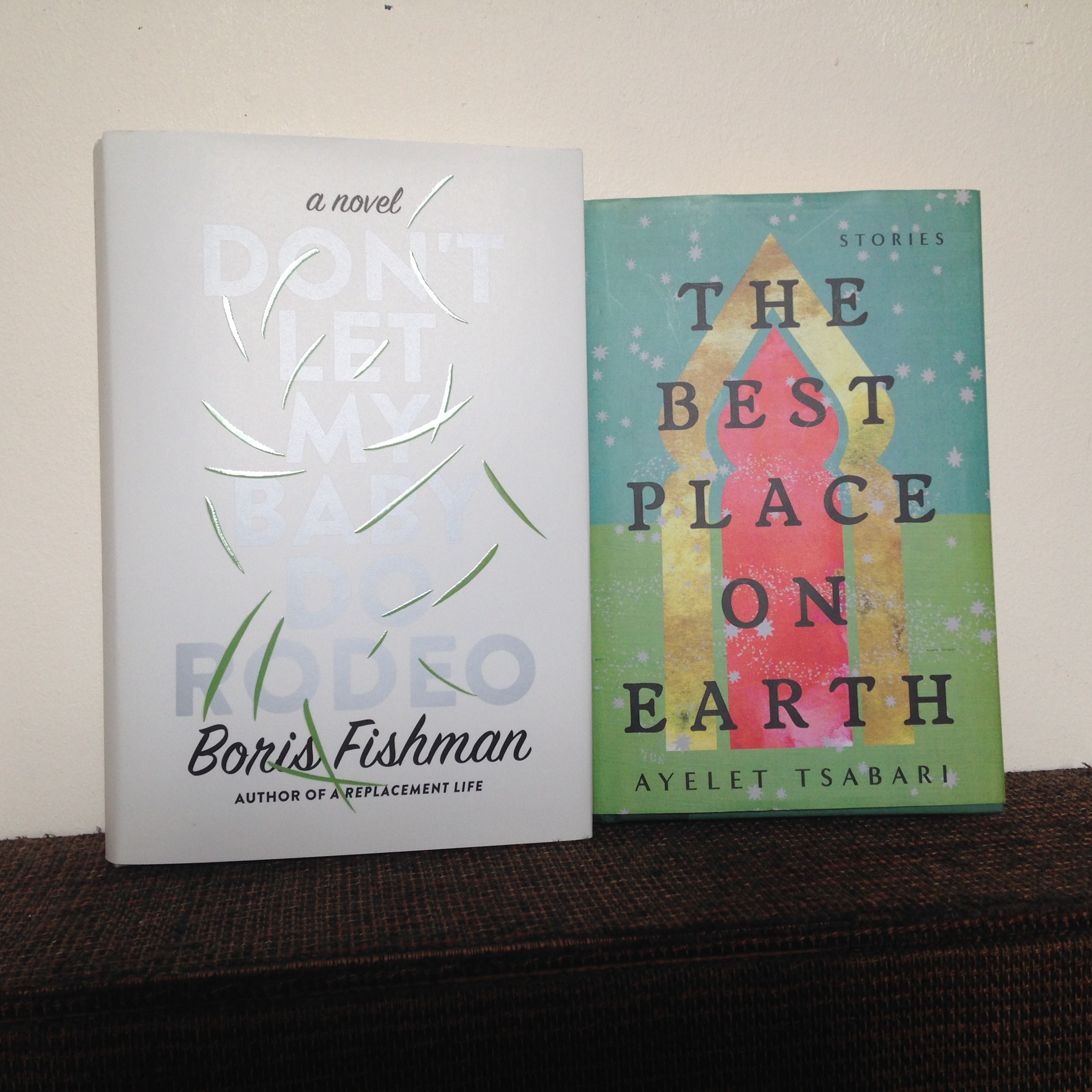 In my examiner article (next paragraph) I write:
"Two fiction books published this month explore what home means for two distinct waves of recent immigrants. Boris Fishman continues to relate the experiences of Russian speaking Jews who immigrated to America in the 1970s, 80s, and 90s in his second novel Don't Let My Baby Do Rodeo, and Canadian-Israeli writer Ayelet Tsabari explores the lives of young Israelis at home and abroad in her debut book of short stories The Best Place on Earth: Stories, which won the Jewish Book Council’s $100, 000 Sami Rohr Prize for Jewish Literature in 2015 for the 2013 Canadian edition."
Also see my New York Journal of Books reviews of the two books:
In my examiner article (next paragraph) I write:
"Two fiction books published this month explore what home means for two distinct waves of recent immigrants. Boris Fishman continues to relate the experiences of Russian speaking Jews who immigrated to America in the 1970s, 80s, and 90s in his second novel Don't Let My Baby Do Rodeo, and Canadian-Israeli writer Ayelet Tsabari explores the lives of young Israelis at home and abroad in her debut book of short stories The Best Place on Earth: Stories, which won the Jewish Book Council’s $100, 000 Sami Rohr Prize for Jewish Literature in 2015 for the 2013 Canadian edition."
Also see my New York Journal of Books reviews of the two books:http://www.nyjournalofbooks.com/book-review/dont-let-my-baby http://www.nyjournalofbooks.com/bo…/b...
Moving is one of life’s most traumatic experiences and all the more so when moving to another country and living in a new language. Two fiction books published this month explore what home means for two distinct waves of recent immigrants. Boris Fishman continues to relate the experiences of Russian speaking Jews who immigrated to America in the 1970s, 80s, and 90s in his second novel Don’t Let My Baby Do Rodeo , and Canadian-Israeli writer Ayelet Tsabari explores the lives of young Israelis at home and abroad in her debut book of short stories The Best Place on Earth , which won the Jewish Book Council’s $100, 000 Sami Rohr Prize for Jewish Literature in 2015 for the 2013 Canadian edition.
In my New York Journal of Books review of Don’t Let My Baby Do Rodeo I synopsize Alex and Maya Rubin’s experiences as adoptive parents and how Maya in the second half of the novel becomes a femme fatale, a role that is foreshadowed earlier in the novel when Alex compares her to Tolstoy’s Anna Karenina:
“Railroad mind”—that was Alex’s term for the hive of Maya’s brain. Railroads made him think of motion, steam, frantic activity. What he really meant was that she was like some Anna Karenina—superfluously melodramatic. And Maya understood what he really meant only because she had a railroad mind.”
The age at which one immigrates also influences one’s ability to adapt to a new country:
“Alex had been ten years younger than Maya’s eighteen when his family had come to America; the Rubins had come for good, whereas Maya had come on an exchange program in 1988, the first year such things were possible. After college, Maya was supposed to return to the USSR—a plan altered by her love affair with Alex and the end of the USSR. Alex had taken to America—he spoke with confidence about Wall Street, the structure of Congress, technology. Maya conceded his authority. Only once had she exclaimed that in twenty years he had almost never left New Jersey, so what did he know? Alex had looked at her as if at a child who doesn’t understand what it means to say things one will later regret, and retreated upstairs. He did not speak to her for three days, their sullen meals spent communicating through Max and his grandparents, and Maya never said that again.”
Tsabari’s Israeli ex-pats are only a few years older than Fishman’s Maya was when she moved to America, and yet for them it is more of a choice. In my New York Journal of Books review of The Best Place on Earth I note how well adapted Tsabari’s Israeli-Canadians are to life in Canada. But in an article in LitHub Tsabari relates how hard won is her ability to write in her second language:
“During those first few years in Canada, even speaking in English was a challenge. I was discouraged by my failure to convey complex thoughts, irritated by my inability to fight with my boyfriend in an eloquent way, embarrassed by my frequent misunderstandings and mispronunciations.”
At a certain point she lacked mastery in both Hebrew and English, a feeling I experienced after living in Israel for five years when I sensed I was forgetting English but still didn’t write well in Hebrew. “My Hebrew was becoming rusty from lack of use, while my English was still not good enough. My dream of writing—the only dream I had ever truly held on to—was slipping away from me.”
While supporting herself by waitressing and cleaning homes and apartment building lobbies, Tsabari forced herself to write in English. Eventually the effort paid off and mirrored her emotional state now that she lived in Canada: “ I was calmer, lighter, more confident, and my English writing was cleaner, more straightforward, less flowery.”
Some of Tsabari’s stories set in Israel capture the stress and tension of living in a country where there is a constant threat of violence, which explains why for Tsabari’s Israeli new Canadians life there feels comparatively calmer.
It is said of the Israeli poet Leah Goldberg that she thought in Russian and wrote in Hebrew, and likewise the quality of Tsabari’s writing in English improved when she allowed Hebrew to influence it:
“Once I let my English writing be inflected with my Hebrew, infused with my voice, my accent, my background, and with the multiplicities of identity—the passion and drama of the Middle East, the oral traditions of my Yemeni ancestors, the tension and urgency of Israel—a new writer emerged.
“… Writing in a language foreign to me and to the place I am depicting seems fitting for a book like mine, preoccupied with in-between-ness. It adds layers of displacement that echo the experience of my characters, travelers, migrants, expats and outsiders who are often at a crossroads, in between places, in between identities, in between languages.”
That experience of displacement is something Fishman and Tsabari’s characters have in common. I conclude my review of Don’t Let My Baby Do Rodeo by writing that it “fulfills and surpasses the promise of [his debut novel] A Replacement Life.” Likewise I write that readers of Tsabari’s The Best Place on Earth will look forward to her novel in progress “with avid anticipation.” For a fuller discussion of these books read my reviews in New York Journal of Books.
Thursday, November 5, 2015
91 year old William Gass' prose is still gorgeous in Eyes: Novellas and Stories

My review appears in New York Journal of Books. Read that review first. Additional remarks (including a longer excerpt from the book and additional biographical info about Gass) that appeared in a different and now defunct publication begin with the next paragraph.
91 year old William Gass' prose is still gorgeous in Eyes: Novellas and Stories
“The brown paper wall bore tears and peels and spots made by drops of who knew what — expectorations past. Yet in such stains lay lakes full of reeds and floating ducks and low loglike boats. Instead of the sort of wall which furnished a rich many-toned background for so many of Atget’s documents: instead of the cobbled courtyard that the remainder of the photo surrounded, shadowed, or stood on; instead of gleaming disks of stone with their dark encircling lines; instead of the leaves of trees in a flutter about a field of figures; there might be — instead — a single pock, the bottom of it whitish with plaster: that’s what he had to look at, descend into, dream about, not a rhyming slope of rock, its layers threaded and inked; not the veins of a single leaf like roads on a map, or a tear of paper resembling a tantrum — his rips didn’t even resemble rips — or faded petals that have fallen like a scatter of gravel at the foot of a vase; not an errant flash of light centered and set like a jewel: instead he had a crack, just a crack in a window, a cob’s web, or that of a spider, dewdrop clinging like an injured climber to its only rope of escape; not a clay flowerpot given the attention due to a landscape; not a scratch on the hood of some vehicle, not directional signs painted on the pavement, instructions worn by the wheels of countless cars; not a black eye enlarged to resemble the purple of a blown rose. These were the images in his borrowed books, the material of his mind’s eye, the Lilliputian world grown taller than that tattered Peruvian giant.” — William H. Gass, “In Camera,” Eyes: Novellas and Stories
Literary critic Steven Moore once called William H. Gass "the finest prose stylist in America." The paragraph quoted above from the first novella in Eyes: Novellas and Stories, 91 year old Gass’ new book of short fiction, is evidence that Moore’s assessment is still accurate. In my New York Journal of Books review of Gass’ new book I write: “The two novellas and four short stories in Eyes show his prose virtuosity and his dim view of human nature undiminished at age 91.”
As in his other works of fiction, the characters in the two novellas and four short stories that comprise Eyes have flawed personalities and most are racist. Gass, who grew up with a racist and abusive father and has cited childhood anger as a major influence on his fiction, has said that he writes “to get even.”
Yet though Gass has an adversarial relationship with his characters they also have some of his own attributes, especially a love of aesthetics with respect to a variety of artistic genres and a tendency to discourse at length on favorite artists and the criteria that define their work.
Eyes’ characters include an unscrupulous fine art photography gallery owner who both verbally abuses and educates his protege/employee, a corporate lawyer overwhelmed by requests for charitable donations and other monetary assistance, the piano from the set of the movie Casablanca, a folding chair, a music professor, and a tween-age boy.
I conclude my NYJB review of Eyes with an enthusiastic recommendation “to readers who enjoy dense prose and experimental fiction” for whom “the attentive reading it requires is amply rewarded.” For a fuller discussion of Eyessee that review.
91 year old William Gass' prose is still gorgeous in Eyes: Novellas and Stories
“The brown paper wall bore tears and peels and spots made by drops of who knew what — expectorations past. Yet in such stains lay lakes full of reeds and floating ducks and low loglike boats. Instead of the sort of wall which furnished a rich many-toned background for so many of Atget’s documents: instead of the cobbled courtyard that the remainder of the photo surrounded, shadowed, or stood on; instead of gleaming disks of stone with their dark encircling lines; instead of the leaves of trees in a flutter about a field of figures; there might be — instead — a single pock, the bottom of it whitish with plaster: that’s what he had to look at, descend into, dream about, not a rhyming slope of rock, its layers threaded and inked; not the veins of a single leaf like roads on a map, or a tear of paper resembling a tantrum — his rips didn’t even resemble rips — or faded petals that have fallen like a scatter of gravel at the foot of a vase; not an errant flash of light centered and set like a jewel: instead he had a crack, just a crack in a window, a cob’s web, or that of a spider, dewdrop clinging like an injured climber to its only rope of escape; not a clay flowerpot given the attention due to a landscape; not a scratch on the hood of some vehicle, not directional signs painted on the pavement, instructions worn by the wheels of countless cars; not a black eye enlarged to resemble the purple of a blown rose. These were the images in his borrowed books, the material of his mind’s eye, the Lilliputian world grown taller than that tattered Peruvian giant.” — William H. Gass, “In Camera,” Eyes: Novellas and Stories
Literary critic Steven Moore once called William H. Gass "the finest prose stylist in America." The paragraph quoted above from the first novella in Eyes: Novellas and Stories, 91 year old Gass’ new book of short fiction, is evidence that Moore’s assessment is still accurate. In my New York Journal of Books review of Gass’ new book I write: “The two novellas and four short stories in Eyes show his prose virtuosity and his dim view of human nature undiminished at age 91.”
As in his other works of fiction, the characters in the two novellas and four short stories that comprise Eyes have flawed personalities and most are racist. Gass, who grew up with a racist and abusive father and has cited childhood anger as a major influence on his fiction, has said that he writes “to get even.”
Yet though Gass has an adversarial relationship with his characters they also have some of his own attributes, especially a love of aesthetics with respect to a variety of artistic genres and a tendency to discourse at length on favorite artists and the criteria that define their work.
Eyes’ characters include an unscrupulous fine art photography gallery owner who both verbally abuses and educates his protege/employee, a corporate lawyer overwhelmed by requests for charitable donations and other monetary assistance, the piano from the set of the movie Casablanca, a folding chair, a music professor, and a tween-age boy.
I conclude my NYJB review of Eyes with an enthusiastic recommendation “to readers who enjoy dense prose and experimental fiction” for whom “the attentive reading it requires is amply rewarded.” For a fuller discussion of Eyessee that review.
Thursday, July 16, 2015
Jewish books: Joshua Cohen’s Book of Numbers is a high tech epic

What happens when a down on his luck luddite novelist is hired to ghostwrite a memoir by a math whiz tech mogul who shares his (and the author of this novel’s) name? …At close to 600 pages of dense prose Book of Numbers is not light reading. I close my NYJB review by recommending it to “readers as ambitious as it is.” — from Jewish books: Joshua Cohen’s Book of Numbers is a high tech epic Also see my New York Journal of Books review. Overall, a challenging but fun and rewarding read!
Jewish books: Joshua Cohen's Book of Numbers is a high tech epic
What happens when a down on his luck luddite novelist is hired to ghostwrite a memoir by a math whiz tech mogul who shares his (and the author of this novel’s) name? That’s the basic premise of Joshua Cohen’s novel Book of Numberswhich was published last month by Random House.
My New York Journal of Books review opens by comparingBook of Numbers’ many allegorical layers to three dimensional chess. The novel is divided into three sections. The first and last feature the ghostwriter who is also the narrator, while in the middle section the tech mogul who calls himself Principal narrates his life story and that of his company to his ghostwriter.
There is a division of opinion among critics as to whose story and which section(s) of the novel is/are more compelling, including between The New York Times’ daily and Sundaybook reviewers. I side with those reviewers who favor the ghostwriter and his sections of the novel. The fictional novelist is more emotionally complex, whereas Principal is an obsessive compulsive, anal retentive, high functioning autistic person whose narrative doesn’t reveal much of an inner life.
One detail many book critics get wrong is the name of the ghostwriter's wife. Early in the novel she is introduced as Rachava and is referred to thereafter as Rach. Numerous critics assume Rach is short for Rachel, but they're wrong; Rach (rhymes with Bach) is short for Rachava.
In interviews in Bomb Magazine and Vice Cohen revealed that to mimic Principal’s obsessive compulsive fixation on numbers each section of the book has an even number of paragraphs in which each paragraph contains an even number of sentences in honor of computer languages’ base 2 binary code and the base 4 employed by search engines .
His ghostwriter, on the other hand reveals himself to be a word maven with a vocabulary exponentially richer than even Norman Mailer’s. When I read Mailer I have to look up a new word every second or third page. For the first 90 or so pages of Book of Numbers I had to look up two or three new words on every page! So is he just showing off? More often than not after looking up the word and then rereading the sentence in which it appears it turns out that the word in question is indeed le mot juste.
The fictional novelist also has a very high degree of Jewish literacy and is authentically comfortable in his Jewishness. That and the fact that like me he writes book reviews and has translated from Hebrew to English makes me predisposed to like him, though that is tempered by his clueless ambivalence towards women.
At close to 600 pages of dense prose Book of Numbers is not light reading. I close my NYJB review by recommending it to “readers as ambitious as it is.” For a fuller discussion of the novel see that review.
Jewish books: Joshua Cohen's Book of Numbers is a high tech epic
What happens when a down on his luck luddite novelist is hired to ghostwrite a memoir by a math whiz tech mogul who shares his (and the author of this novel’s) name? That’s the basic premise of Joshua Cohen’s novel Book of Numberswhich was published last month by Random House.
My New York Journal of Books review opens by comparingBook of Numbers’ many allegorical layers to three dimensional chess. The novel is divided into three sections. The first and last feature the ghostwriter who is also the narrator, while in the middle section the tech mogul who calls himself Principal narrates his life story and that of his company to his ghostwriter.
There is a division of opinion among critics as to whose story and which section(s) of the novel is/are more compelling, including between The New York Times’ daily and Sundaybook reviewers. I side with those reviewers who favor the ghostwriter and his sections of the novel. The fictional novelist is more emotionally complex, whereas Principal is an obsessive compulsive, anal retentive, high functioning autistic person whose narrative doesn’t reveal much of an inner life.
One detail many book critics get wrong is the name of the ghostwriter's wife. Early in the novel she is introduced as Rachava and is referred to thereafter as Rach. Numerous critics assume Rach is short for Rachel, but they're wrong; Rach (rhymes with Bach) is short for Rachava.
In interviews in Bomb Magazine and Vice Cohen revealed that to mimic Principal’s obsessive compulsive fixation on numbers each section of the book has an even number of paragraphs in which each paragraph contains an even number of sentences in honor of computer languages’ base 2 binary code and the base 4 employed by search engines .
His ghostwriter, on the other hand reveals himself to be a word maven with a vocabulary exponentially richer than even Norman Mailer’s. When I read Mailer I have to look up a new word every second or third page. For the first 90 or so pages of Book of Numbers I had to look up two or three new words on every page! So is he just showing off? More often than not after looking up the word and then rereading the sentence in which it appears it turns out that the word in question is indeed le mot juste.
The fictional novelist also has a very high degree of Jewish literacy and is authentically comfortable in his Jewishness. That and the fact that like me he writes book reviews and has translated from Hebrew to English makes me predisposed to like him, though that is tempered by his clueless ambivalence towards women.
At close to 600 pages of dense prose Book of Numbers is not light reading. I close my NYJB review by recommending it to “readers as ambitious as it is.” For a fuller discussion of the novel see that review.
Tuesday, May 19, 2015
Books: Nell Zink's smart and witty 2nd novel Mislaid

"Looking for a brainy yet breezy novel that addresses gender, race, and class issues with levity and has a happy ending? Try Nell Zink’s Mislaid, her second published novel following her critically well-received debut The Wallcreeper in 2014." -- from my New York Journal of Books book review: Mislaid: A Novel by Nell Zink
"To sum up, Mislaid is an entertaining book worth reading on a plane or train ride to a vacation destination or on a poolside chaise lounge when you get there." -- from my examiner article, Books: Nell Zink's 2nd novel Mislaid is smart and witty
Monday, April 7, 2014
Books: in David Grand's Mount Terminus both protagonist and Los Angeles come of age

"David Grand’s third novel, Mount Terminus, is written in luscious, erudite prose so dense his readers have no choice but to read it slowly."
-- from my review of Mount Terminus by David Grand on New York Journal of Books. Additional remarks that appeared in a different and now defunct publication begin with the next paragraph.
Books: in Mount Terminus both protagonist and Los Angeles come of age
From the time this country annexed what was then northern Mexico in 1848 New Yorkers have been moving to California to start their lives anew. In David Grand's third novel Mount Terminus (published last month by New York based publisher Farrar, Straus and Giroux) a father and son move from New York to the outskirts of Los Angeles, and the boy nicknamed "Bloom" and his new home come of age in the movie business in the first decades of the Twentieth Century.
In my New York Journal of Books Review I describe Mr. Grand's novel as "written in luscious, erudite prose so dense his readers have no choice but to read it slowly." I recommend the book but only to sophisticated readers; as I read the novel I kept a Wikipedia app handy to look up cultural references.
I first became aware of Mount Terminus when I read an excerpt in Tablet Magazine. But as the novel progresses there is less and less Jewish content, perhaps accurately reflecting a process of assimilation. For a fuller discussion of the book read my NYJB review.
 David Grand
Thursday, February 27, 2014
Jewish books: Ellen Litman's Mannequin Girl describes childhood in 1980s Moscow

In my New York Journal of Books review I describe Ellen Litman's second novel Mannequin Girl as “a welcome addition to the coming of age genre that will appeal both to adult readers and to precocious teenagers.” Also see my examiner article about this novel set in 1980s Moscow, which begins with the next paragraph.
Jewish books: Ellen Litman's Mannequin Girl describes childhood in 1980s Moscow
To those of us who participated in rallies and other activities in the 1970s and 1980s on behalf of the right of Jews living in the Soviet Union to emigrate the complete lack of Jewish ritual observance in the family life of Kat Knopman and her parents Misha and Anechka in 1980s Moscow as depicted in Ellen Litman’s second novel Mannequin Girl (forthcoming from W.W. Norton in the middle of next month) will come as no surprise. Kat has a physical disability and attends a school for children with her condition, and amid increasing anti-Semitism during the USSR’s final years her Jewishness also becomes a disadvantage.
What is surprising is how normal Kat’s childhood seems despite her disability and the novel’s setting. Some aspects of childhood—friendships, rivalries, and being both the victim and perpetrator of malicious behavior—are more or less the same in most countries.
I related to Kat on a personal level, because like her I am the child of intellectual parents, and during my childhood and young adulthood I too felt the burden of being expected to realize my potential.
In my New York Journal of Books review I describe Mannequin Girl as “a welcome addition to the coming of age genre that will appeal both to adult readers and to precocious teenagers.”
 Ellen Litman
Sunday, January 19, 2014
Books: E.L. Doctorow's novel Andrew's Brain explores a brain scientist's mind
 In my New York Journal of Books review I describe E.L. Doctorow's new novel as “an enjoyable page turner” that is “both bittersweet and disturbing.” Additional remarks that appeared in a different and now defunct publication begin with the next paragraph.
Books: E.L. Doctorow's novel Andrew's Brain explores a brain scientist's mind
Last Tuesday, April 14, 2014, New York publisher Random House published Andrew’s Brain, the new novel by multiple award winning writer E.L.Doctorow whose writing and publishing career spans half a century. In my New York Journal of Books review I note that Andrew’s Brain has more in common with Doctorow’s short stories than with his novels.
Doctorow’s novels usually feature a large cast of characters with narratives reflecting multiple perspectives. Andrew’s Brain is more like a monologue in which the title character narrates his life story to a therapist. Andrew is a neuroscientist whose life work is studying how the brain creates the mind. In the novel he explores his own mind with his therapist.
The publication of the book is timely. Last spring President Obama announced the Brain Research through Advancing Innovative Neurotechnologies (BRAIN) Initiative, a federally funded project to begin in fiscal year 2014 to map the activity of every neuron in the human brain.
But readers hoping to learn something about neuroscience will be disappointed; the novel shows little evidence that Doctorow has devoted the kind of extensive background research to brain science as he did to the historical settings of his previous novels. Nonetheless Andrew’s Brain succeeds as a work of fiction which I describe in my NYJB review as “an enjoyable page turner” that is “both bittersweet and disturbing.” For a fuller discussion of the book read my NYJB review.
Wednesday, January 8, 2014
Book review | Leaving the Sea: Stories by Ben Marcus

In my NYJB review of Leaving the Sea by Ben Marcus I recommend the book "to serious readers who will want to reread its stories gaining new insights with each reading.” Additional remarks that appeared in a different and now defunct publication begin with the next paragraph.
Tuesday, March 20, 2012
Book review: Left-Handed: Poems by Jonathan Galassi
In my New York Journal of Books review I compare Jonathan Galassi’s new book Left-Handed: Poems to the movie Beginners and recommend it “to all poetry lovers and to all readers who find they must radically change their lives in order to live more authentically.” via the late examiner.com

New York Journal of Books
In the movie Beginners Christopher Plumber plays a man who in late middle age falls in love with a younger man and discovers that he is gay. Jonathan Galassi‘s new book, Left-Handed: Poems (published today by Knoft), tells a nearly identical story. The book’s title poem wistfully wonders what the author’s life would have been like had he embraced his sexuality earlier in life but does not consider the sad irony that had he lived more authentically from his twenties in the 1970s onward he might not have survived the AIDS epidemic in the 1980s.
In my New York Journal of Books review I recommend Left-Handed: Poems “to all poetry lovers and to all readers who find they must radically change their lives in order to live more authentically.” In addition to writing poetry, Mr. Galassi also translates Italian poetry into English and is the President and Publisher of Farrar, Straus and Giroux, one of New York’s eight largest publishers.
Tuesday, January 17, 2012
NY Jewish books: The Flame Alphabet by Ben Marcus
A language epidemic erupts among Jewish families; children’s speech makes their parents deathly ill. Soon it spreads to the rest of the population. This dark fantasy is the premise of Jewish New Yorker Ben Marcus‘s new novel, The Flame Alphabet published today by Knopf. In my New York Journal of Books review I write,
 New York Journal of Books
“Ben Marcus was already known as a daring, experimental writer’s writer on the strength of his three previous books of fiction. The good news for the general reading public is that his fourth book, The Flame Alphabet, is his most accessible to date, and its comparative clarity and linearity in no way diminishes its power, inventiveness, and originality. The quality of the writing also compensates for the book’s thin character development. Instead, Mr. Marcus deploys his potent prose to tell a tale about a world in which all language becomes lethal.”
One of Mr. Marcus’ inventions is a new form of Judaism in which couples worship in forest hideouts on Thursdays instead of Friday nights and Saturdays. Like the epidemic itself, this aspect of the novel requires a suspesion of disbelief. The ominous nature of the fictional events lends the narrative a sense of gravitas that Mr. Marcus’ prose style is well equiped to express. While the book has all the necessary elements to make it a cult classic, a book this well written deserves the widest possible audience.
Saturday, January 1, 2011
Jewish Literature 101: Recommended Jewish fiction and poetry books of 2010

Now that another secular calendar year is beginning I would like to share my recommendations of Jewish fiction and poetry books published last year. This is not a "best of" list, merely a list of Jewish themed books published in 2010 that I have actually read and reviewed at my other writing gig as a book reviewer at New York Journal of Books.
Read the entire article on examiner.com

Subscribe to:
Posts (Atom)