Tuesday, August 5, 2014

Jewish books: Stephanie Feldman's The Angel of Losses is an auspicious debut

angeloflossesbookcover "Stephanie Feldman’s debut novel The Angel of Losses, which was published last week by New York-based HarperCollins imprint Ecco Press, is a welcome addition to the Jewish fantasy fiction genre." --examiner.com

In my New York Journal of Books review of the novel I write, “The Angel of Losses is recommended to nerdy (in the best sense of the word) secular Jewish and philo-Semitic readers whose genre interests include the confluence of contemporary and fantasy fiction.” Read that review first. Additional remarks that appeared in a different and now defunct publication begin with the next paragraph.

Jewish books: Stephanie Feldman's The Angel of Losses is an auspicious debut

Stephanie Feldman’s debut novel The Angel of Losses, which was published last week by New York-based HarperCollins imprint Ecco Press, is a welcome addition to the Jewish fantasy fiction genre. In my New York Journal of Books review of the novel I write, “The Angel of Losses is recommended to nerdy (in the best sense of the word) secular Jewish and philo-Semitic readers whose genre interests include the confluence of contemporary and fantasy fiction.”

The novel might also appeal to the growing number of gentiles who, like its protagonist Marjorie Burke, discover they have Jewish ancestry, as well as to those who always knew that a parent or grandparent is Jewish. In my NYJB review I cite the case of former Secretary of State Madeleine Albright who learned at age 60 that her parents were Jewish apostates. Current Secretary of State John Kerry, on the other hand, has always known that his paternal grandparents were born Jewish. In my own family some of my paternal great-uncles married Protestants and raised their children in their mother’s faith. But one of my dad’s Protestant first cousins was fascinated by her Jewish father’s religious heritage, converted to Judaism, and married a rabbi.

In The Angel of Losses Marjorie’s sister Holly converts to Judaism without knowing about her grandfather’s ancestry. What tips Marjorie off that her late grandfather might have been Jewish are stories he wrote about a character he called The White Rebbe. The stories also draw the attention of her brother-in-law Nathan who is a member of a mystical Jewish sect called The Berukhim Penitents who are mentioned in the stories.

Feldman does not refer to the Berukhim Penitents as Hasidic, and even dates the sect’s founding to the Sixteenth Century thus predating Hasidism which started in the Eighteenth Century, but the Hasidim are the only sects who call their rabbis rebbe. Moreover the Berukhim Penitents are so preoccupied with the coming of the messiah that when their rabbinic leader died centuries ago no successor was chosen, and instead they await their deceased rabbi’s return.

This sounds a lot like the Bratslav (or Breslov) Hasidim who have remained devoted to their story telling rebbe Nachman since his death in 1810 and have never chosen a successor, and instead await Nachman’s return as the messiah. Chabad Lubovitch is another messianic Hasidic sect that has not chosen a successor since it’s seventh rebbe’s death in 1994 and likewise awaits his messianic return. Feldman’s fictional Berukhim Penitents combine aspects of both sects, and like the Lubovitch Hasidim were originally based in Lithuania, whereas the Bratslav Hasidim were from the Ukraine. In his doctoral dissertation Conservative Rabbi David Siff points out that the two sects that don't have a living rebbe are the most messianic of all the Hasidic sects.

One detail that seemed odd to me was when Feldman referred to Lithuanian Orthodox synagogues as temples. Reform Judaism often refers to its houses of worship as temples, but that appellation is rarely used among the Orthodox. But that is a minor quibble that is easy to overlook in this entertaining and enjoyable read. For a fuller discussion of the novel read my NYJB review.sbfeldman Stephanie Feldman

Wednesday, July 2, 2014

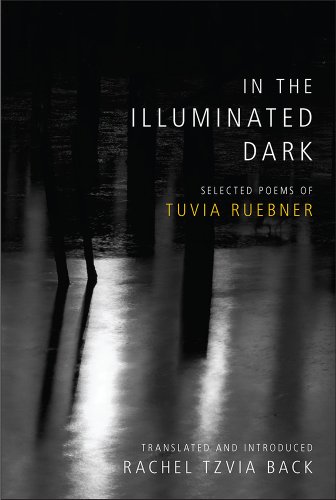
Book review: In the Illuminated Dark: Selected Poems of Tuvia Ruebner

intheilluminateddarkbookcover    "Anglophone readers (especially those who also read Hebrew) will find both this handsome book’s bilingual presentation of Ruebner’s selected poems, and his heart wrenching backstory described by translator Rachel Tzvia Back in her informative introduction and endnotes, compelling reading."

My two part review begins with the poet's bio and backstory in New York Journal of Books and continues with a discussion of his poems in an article that appeared in a different and now defunct publication, which begins with the next paragraph.

Israeli books: In the Illuminated Dark: Selected Poems of Tuvia Ruebner

Although Tuvia Ruebner is the author of 15 books of poetry in Hebrew and nine translated into German spanning six decades, twice winner of Israel’s Prime Minister’s Prize, 2008 winner of the Israel Prize, as well as Germany’s Konrad Adenauer Prize, only a handful of his poems were available in English in anthologies and literary magazines prior to the joint publication this spring by by Hebrew Union College Press and University of Pittssburgh Press of In The Illuminated Dark, a bilingual edition of his selected poems translated by Rachel Tzvia Back. I am grateful to Adam Kirsch's Tablet article on Ruebner which introduced me to this amazing poet.

In my New York Journal of Books review I write, “Anglophone readers (especially those who also read Hebrew) will find both this handsome book’s bilingual presentation of Ruebner’s selected poems, and his heart wrenching backstory described by translator Rachel Tzvia Back in her informative introduction and endnotes, compelling reading.” See that review for the backstory.

Suffice to say that the predominant theme in Ruebner’s poetry is loss; loss of parents, grandparents and a sister in the Shoah, of his first wife to a traffic accident, and of his youngest son Moran who cut off contact with his parents during a trip overseas. In the untitled poem that begins the section of the book entitled History Reubner lists all the relatives, friends and colleagues whom he has lost devoting one line to each person in the 30 line poem except for Moran who gets five lines. Ruebner also refers to Moran in the poems “1983” (1990), “Soldiers’ Memorial Day” and “Moonlit Night (2)” (2002), “Not Every Day” (2009), and “A Meeting in Venice,” “Avraham,” “Father,” and “He” (2013).

“Not Every Day” is an apology. When Moran returned from combat in Israel’s first Lebanon War he had changed, but his parents didn’t notice. Ruebner doesn’t specify how Moran had changed; perhaps he had PTSD. On his way to South America Moran stopped in Cambridge, MA where his father was spending a sabbatical at Harvard to bid his parents farewell. After a few letters all traces of him were lost. In “Not Every Day” Ruebner writes,

“I embraced you there when we parted at the winter airport,

a leave-taking seared into my flesh. You asked ‘why?’

for something foreign had wormed its way between us after that cursed war.

You returned to us different from what you had been before, but I was

tense, unable to concentrate, troubled by the sabbatical that had

come to nothing.

How sorry I am, how deeply repentant, for not understanding

what you went through without us, for responding severely.”

After telling Moran how much he misses him Ruebner concludes the poem, “Self pity is contemptible. But your love is eating me alive.”

It’s probably just a coincidence, but the venue and the line “something foreign had wormed its way between us” reminds me of a Turkish Jewish character in Mario Levi’s novel Istanbul Was a Fairy Tale who becomes a Mormon while studying at Harvard and writes to his family informing them that he intends to have no further contact with them. But in Reubner’s case it is the parent who is at Harvard and the adult child is only passing through en route to another destination, so the coincidence in all likelihood is only a superficial resemblance.

In “He” Ruebner writes about not being able to stop thinking about him (presumably Moran) and even wanting to kill him, which calls to mind the parents in David Grossman’s Falling Out of Time who are tormented by the memory of their deceased children. Writing is Ruebner’s only remedy: “Only when I write about him does he leave me be.”

Not all of Ruebner’s poems are that bleak. “What Joy” (2013) describes the joy Ruebner feels upon learning he has become a great-grandfather and ends with “…a great-grandfather embracing a great-grandmother/and kissing her on the mouth as though he were a boy of twenty.” “Chimes” (2009) playfully closes with a feminine rhyme of his wife’s name Galila and the Hebrew word for chimes mitsilah, which in turn resembles the Hebrew verb to save or rescue hitsil; perhaps he is crediting Galila with psychologically rescuing him.

Neither of Ruebner’s remaining children live in Israel. Miriam, his daughter from his first marriage married a man from Iceland and lives there with her children and grandchildren, and his son Idan is a Buddhist monk who lives in Nepal, but both are in frequent telephone contact with Ruebner. I wonder whether Reubner’s ambivalence about Israel, which he expresses in his protest poems, influenced his children’s decision to emigrate.

There is a saying among literary translators that literal word for word fidelity to a text betrays the text. In my NYJB review I praise Back’s translation of Ruebner’s poetry which she creatively does not betray. In “Poem” (2009), for example, Ruebner’s rhyming couplet in the fourth stanza does not rhyme in English, but in the fifth stanza Back adds a word not found in the Hebrew to achieve a slant rhyme. And while the first word of the second line of “The Tower of Babel (2)” (1999) means “blind” in both versions, in the Hebrew the adjective blind modifies a noun in the first line, while in Back’s English version it modifies a different noun in the second line.

Ruebner is an award winning translator between Hebrew and German (Agnon into German and Goethe into Hebrew) and in all likelihood appreciates both the difficulties his verse posed for Back and her workarounds. Next spring Late Beautya book of Ruebner’s recent poems translated by a different team of translators will be published by Zephyr Press, and it will be interesting to compare their versions with Back’s.

I urge readers who have at least intermediate proficiency in Hebrew to use a dictionary or dictionary app and read Ruebner in the original, and I likewise urge those readers who have only prayerbook Hebrew to read the poems out loud even without understanding what the words mean to get some sense of the music of Ruebner’s poetry.

Ruebner is also a gifted photographer, and his poetry is not only sonorous but also visual, especially his travel, nature, and ekphrastic poems. Let’s conclude with his “Untitled” (2013)

“Like leaves driven in wind.

Like tattered remnants of a scene.

Like a night’s sobbing.

Like the moon’s red blindness.

Like the abyss of four in the morning.

Not like.”
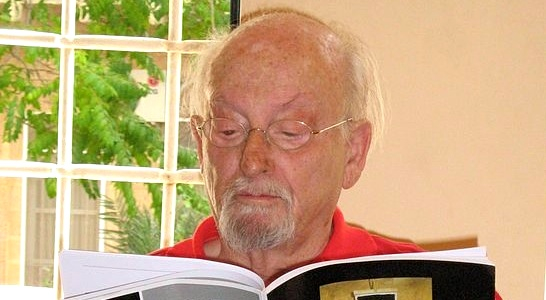
tuviaruebnerTuvia Ruebner

Saturday, June 7, 2014

Book review: A Replacement Life by Boris Fishman


Image
Slava Gelman, the protagonist of Boris Fishman's debut novel A Replacement Life, fabricates Holocaust narratives for elderly Russian immigrants' reparations claims applications. In my NYJB review I write, "Slava knows that to make his stories convincing he has to get the details right, and despite the leaps of faith Fishman demands he provides more than enough correct details and well crafted figurative turns of phrase to convince most readers to go along with him—and those who do will be amply rewarded by this multidimensional and handsomely written debut novel." For additional remarks about A Replacement Life see my examiner article, which begins with the next paragraph.

Meet Boris Fishman the newest star novelist of the Little Odessa Renaissance

With the publication this week of his debut novel A Replacement Life by New York based publisher HarperCollins Boris Fishman joins the ranks of fellow writers of The Little Odessa Renaissance who immigrated from the Soviet Union to The United States and Canada as children including Gary Shteyngart, David Bezmogis, Anya Ulinich, Nadia Kalman, and Ellen Litman all of whom explore the theme of having one foot in Russian and the other in American culture.

Fishman’s protagonist Slava Gelman is an aspiring writer who fabricates Holocaust narratives for fraudulent reparation applications on behalf of Russian Jewish immigrants of his grandparents’ generation. In my New York Journal of Books review of the novel I write, “Slava knows that to make his stories convincing he has to get the details right, and despite the leaps of faith Fishman demands he provides more than enough correct details and well crafted figurative turns of phrase to convince most readers to go along with him—and those who do will be amply rewarded by this multidimensional and handsomely written debut novel.”

I really enjoyed reading A Replacement Life, but besides “the leaps of faith” my other reservation concerns the way Fishman portrays his fellow immigrants from the former Soviet Union as a community of liars and cheats. I hope that defamatory characterization is an overly broad generalization. For a more detailed discussion of the novel read my New York Journal of Books review.
ImageBoris Fishman

Friday, April 18, 2014

Books: poet C.K. Williams turns to prose in All at Once

Image
“It is probably not fair to compare C. K. Williams’ prose in All at Once with his award winning verse poetry books, but it does offer poetry averse readers an opportunity to engage with a perceptive and empathic wordsmith whose work they otherwise would not encounter.” —From my NYJB book review.  Read that review first. Additional remarks that appeared in a different and now defunct publication begin with the next paragraph.

Books: In All at Once poet C.K. Williams turns to prose

More than two decades ago a creative writing grad school classmate related how a prospective employer told her she would not get the publishing job for which she had applied, because "poets can't write prose." If prose memoirs by poets such as Mary Karr had not already disproved that canard, All at Once, poet C.K Williams' new book of short prose pieces, surely would.

During the middle decades of Williams' poetic oeuvre he used very long lines, lines so long that perhaps it's not that much of a stretch for him to dispense with line breaks entirely in All at Once and switch to prose (after all, novelistDavid Albahari has shown that paragraph breaks are also dispensable). On the other hand, it might be an interesting creative writing exercise to put line breaks into Williams' prose in All at Once.

There is no consensus on what defines or how to write a prose poem, nor on whether to emphasize the prose or the poetry. In the 19th Century French symbolist poets wrote poetic prose pieces featuring a lyrical voice and poetic imagery. That approach was also favored by the late American writer Carol Novack, the founder of Mad Hatters Review. OTOH, prose poets such as Phyllis Koestenbaummake the prose in her prose poems as prosy as possible. Williams uses both approaches in the varied pieces that comprise All at Once, some of which seem more like essays.

In my New York Journal of Books review of All at Once I write, "It is probably not fair to compare C. K. Williams’ prose inAll at Once with his award winning verse poetry books, but it does offer poetry averse readers an opportunity to engage with a perceptive and empathic wordsmith whose work they otherwise would not encounter." See that review for a fuller discussion of the book.
ImageC.K. Williams

Monday, April 7, 2014

Books: in David Grand's Mount Terminus both protagonist and Los Angeles come of age

Image
 "David Grand’s third novel, Mount Terminus, is written in luscious, erudite prose so dense his readers have no choice but to read it slowly." 
-- from my review of Mount Terminus by David Grand on New York Journal of Books. Additional remarks that appeared in a different and now defunct publication begin with the next paragraph.

Books: in Mount Terminus both protagonist and Los Angeles come of age

From the time this country annexed what was then northern Mexico in 1848 New Yorkers have been moving to California to start their lives anew. In David Grand's third novel Mount Terminus (published last month by New York based publisher Farrar, Straus and Giroux) a father and son move from New York to the outskirts of Los Angeles, and the boy nicknamed "Bloom" and his new home come of age in the movie business in the first decades of the Twentieth Century.

In my New York Journal of Books Review I describe Mr. Grand's novel as "written in luscious, erudite prose so dense his readers have no choice but to read it slowly." I recommend the book but only to sophisticated readers; as I read the novel I kept a Wikipedia app handy to look up cultural references.

I first became aware of Mount Terminus when I read an excerpt in Tablet Magazine. But as the novel progresses there is less and less Jewish content, perhaps accurately reflecting a process of assimilation. For a fuller discussion of the book read my NYJB review.
ImageDavid Grand

Tuesday, March 25, 2014

David Grossman conveys parental bereavement in Falling Out of Time

Image
“As moving as are each of these expressions of grief the cumulative effect of Falling Out of Time‘s nearly 200 pages is even more powerful. It certainly conveys bereaved parents’ pain to readers who have not suffered that loss and may help some mourning parents work through their grief, though others may feel it reopens emotional wounds.” -- from my New York Journal of Books review of David Grossman's new multi-genre book. Additional remarks that appeared in a different and now defunct publication begin with the next paragraph.

Israeli books: David Grossman describes losing a child in Falling Out of Time

For most of human history and pre-history childhood mortality was a fact of life, and couples had many children in the hope that at least some of them would live long enough to become adults. As recently as the Nineteenth Century many if not most adults survived the loss of one or more siblings who had succumbed to childhood illnesses, and parents losing children to those illnesses was quite common. The desire to reconnect with lost loved ones made surviving relatives vulnerable to charlatans posing as spiritualists.

Only since the Twentieth Century has medical science advanced to the point where parents could realistically expect all their children to reach adulthood, an expectation that has resulted in parents choosing to have fewer children and which perhaps makes the loss of a child all the more painful. It is that particularly poignant pain that Israeli writer David Grossman (one of whose sons died in combat in Israel's 2006 war against Hezbollah) captures in his new book Falling Out of Time which will be published tomorrow by New York based publisher Knopf.

Part poetry, part prose, and part play, the characters in Falling Out of Time address their dead children and share their grief with one another. In my New York Journal of Books review of the book I write:

“As moving as are each of these expressions of grief the cumulative effect of Falling Out of Time‘s nearly 200 pages is even more powerful. It certainly conveys bereaved parents’ pain to readers who have not suffered that loss and may help some mourning parents work through their grief, though others may feel it reopens emotional wounds.”

For a fuller discussion of the book see my NYJB review.
Image David Grossman